
Nano Banana 2.1: Features, Release Date & What’s New
Nano Banana 2.1 Is Officially Here
Released on October 6, 2026. See what’s new, how it compares with Nano Banana 2, and where to use it today.


Nano Banana 2.1 is now officially released. Google lists it as a Stable Gemini API model with the ID gemini-nano-banana-2.1, describing it as an update to Nano Banana 2 (Gemini 3.1 Flash Image).
Before launch, the name first appeared as a Google Flow build label. In late September 2026, TestingCatalog reported that Flow references moved from “Nano Banana 2.5 Flash” to “Nano Banana 2.1.” That rumor phase is now release history — not the current status.
This article covers the official launch, what’s confirmed vs earlier rumor, how Nano Banana 2.1 compares with Nano Banana 2, and a capability-based review of Nano Banana 2 as the previous-generation baseline. It is not an independent Designkit benchmark of either model.
What Is Nano Banana 2.1?
Nano Banana 2.1 is Google's latest high-efficiency image generation and conversational editing model, released as an update to Nano Banana 2 (Gemini 3.1 Flash Image). Its model ID is gemini-nano-banana-2.1.
Google positions it as keeping Flash-level speed and cost efficiency while improving visual quality, prompt adherence, multi-turn consistency, text rendering, and search grounding. It supports 1K, 2K, and 4K output, along with wide and panoramic aspect ratios such as 1:4, 4:1, 1:8, and 8:1.
It sits as the high-efficiency counterpart to Gemini 3 Pro Image (Nano Banana Pro) — faster / volume-oriented Flash-tier work, not the Pro-tier “maximum fidelity” option.
Release history context: before the October 6, 2026 launch, the 2.1 name was spotted as a Flow label after an earlier “2.5 Flash” string. That timeline explains how the name entered public discussion; it is no longer the primary evidence that the model exists.
Is Nano Banana 2.1 Released? Release Date and Availability
Yes. Google officially released Nano Banana 2.1 on October 6, 2026, with the stable model ID gemini-nano-banana-2.1.
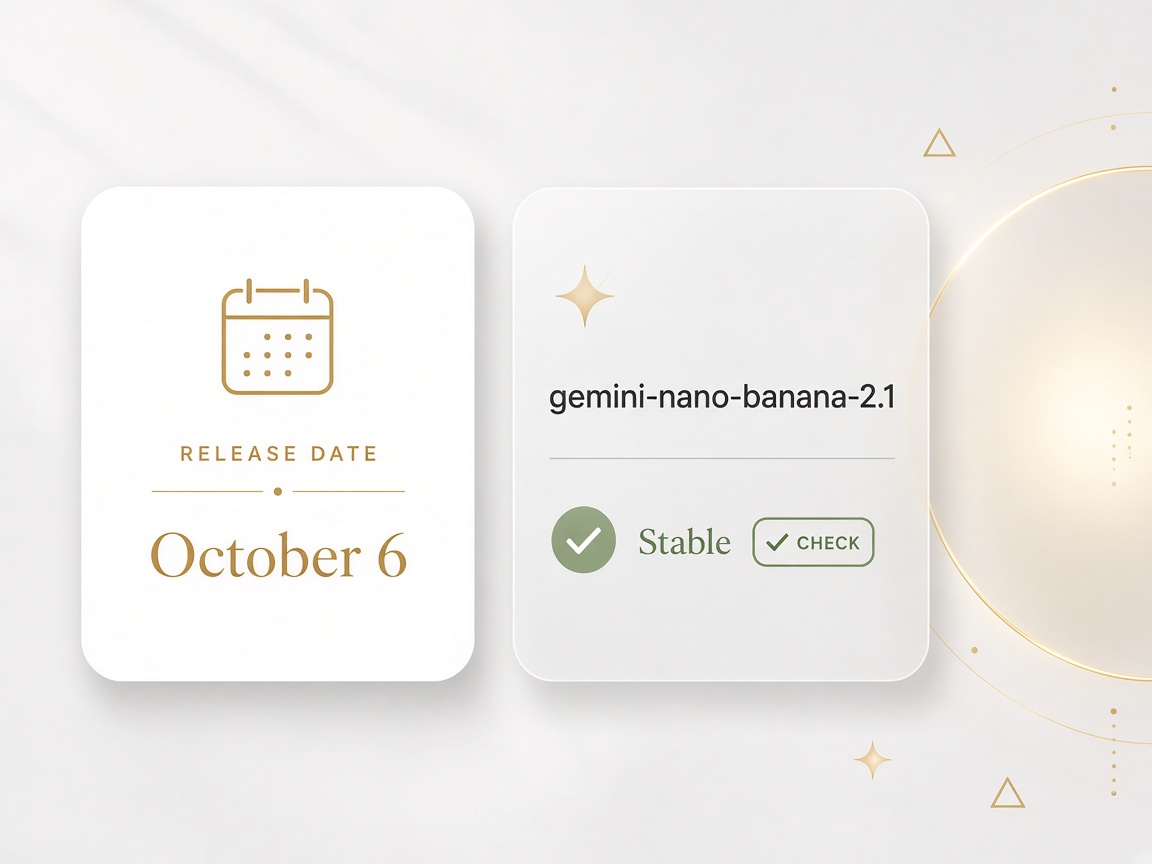
Google’s Gemini API documentation describes Nano Banana 2.1 as the latest high-efficiency image generation and conversational editing model, with improvements in visual quality, prompt adherence, multi-turn consistency, and text rendering.
Google now lists Nano Banana 2.1 as the recommended replacement for Nano Banana 2 (gemini-3.1-flash-image), which has an October 29, 2026 shutdown date in the current Gemini API deprecations schedule.
| Detail | Status |
|---|---|
| Official announcement | Yes |
| Release date | October 6, 2026 |
| Model ID | gemini-nano-banana-2.1 |
| API | Available |
| Status | Stable |
| 4K output | Yes (1K / 2K / 4K; default 1K) |
| Search grounding | Yes (Web + Image Search) |
| Reference images | Up to 14 |
| Thinking levels | minimal / medium / high |
| Recommended replacement for | Nano Banana 2 (gemini-3.1-flash-image), shutdown October 29, 2026 |
Google’s current public Nano Banana lineup includes Nano Banana 2.1, Nano Banana 2, Nano Banana 2 Lite, and Nano Banana Pro.
Nano Banana 2.1 Timeline
| Date | Event |
|---|---|
| Sep 2026 | Early reports and Flow sightings used “Nano Banana 2.5 Flash” and later “Nano Banana 2.1” |
| Oct 6, 2026 | Google officially released Nano Banana 2.1 as gemini-nano-banana-2.1 |
The Flow labeling period explains how the 2.1 name entered public discussion. The October 6 Gemini API release is the confirmed launch point.
What Was Rumor vs. What Is Now Confirmed
| Claim | Current status |
|---|---|
| 2.1 has a specific MoE architecture | Not confirmed |
| 2.1 costs $0.03–$0.07 per image | Verify against current pricing; don’t use unless sourced |
| “spicy-mayo” was 2.1 | Not officially confirmed |
| 2.1 supports 4K | Confirmed |
| 2.1 supports up to 14 reference images | Confirmed |
| 2.1 supports up to 4 characters and 10 objects | Confirmed in Gemini API docs |
| 2.1 has a public API | Confirmed |
| 2.1 has a stable model ID | Confirmed (gemini-nano-banana-2.1) |
A website using “Nano Banana 2.1” in its product name still does not automatically prove it is calling Google’s official gemini-nano-banana-2.1 endpoint. Prefer Google’s Gemini / AI Studio / API surfaces when you need the real model.
Nano Banana 2.1 vs Nano Banana 2
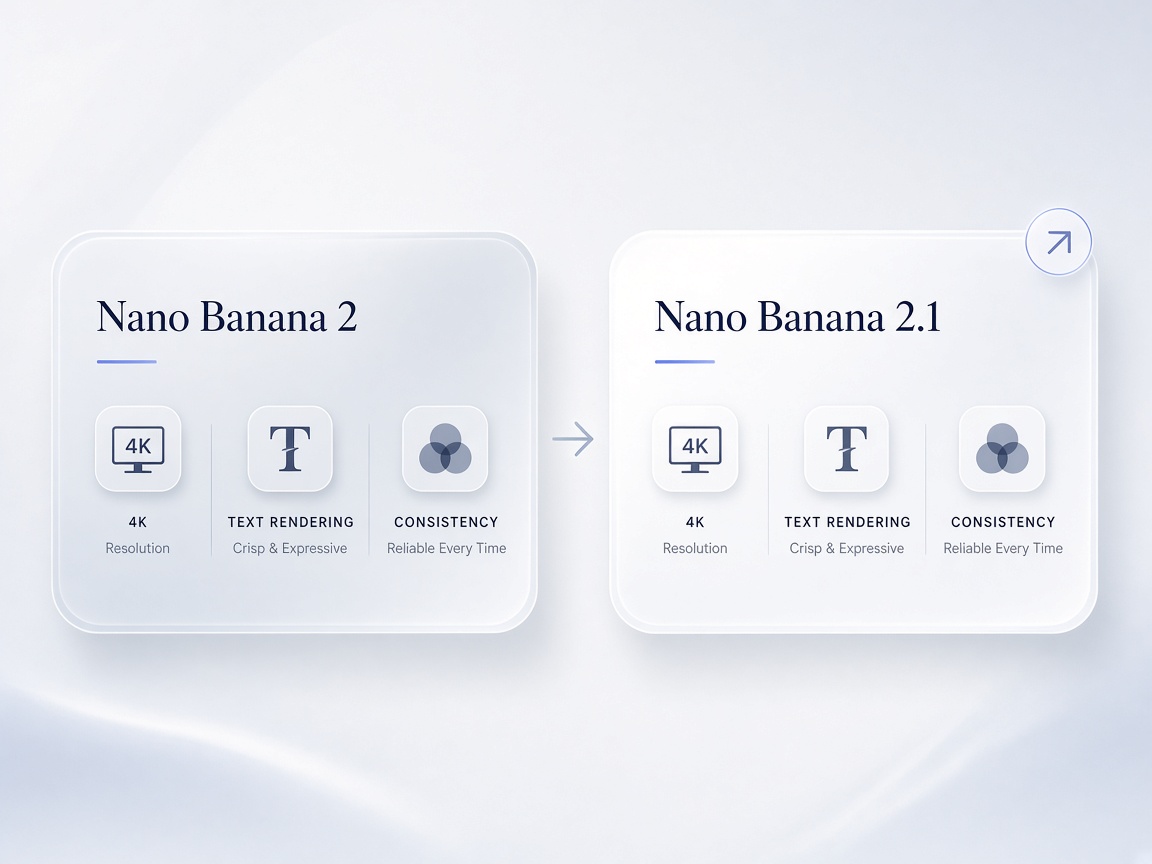
Google describes Nano Banana 2.1 as an update to Nano Banana 2, keeping its high-efficiency positioning while improving visual quality, typography, prompt adherence, and multi-turn consistency.
| Feature | Nano Banana 2 | Nano Banana 2.1 |
|---|---|---|
| Status | Previous-generation Stable | Current Stable |
| Model ID | gemini-3.1-flash-image | gemini-nano-banana-2.1 |
| Positioning | High-efficiency image generation | Updated high-efficiency image generation |
| Deprecation | Shutdown October 29, 2026 | No shutdown date announced |
| Recommended replacement | Nano Banana 2.1 | — |
| Resolutions | 0.5K / 1K / 2K / 4K | 1K / 2K / 4K (default 1K; no 0.5K) |
| Wide / panoramic ratios | Yes (1:4, 4:1, 1:8, 8:1) | Yes, with documented tiling fixes at 2K / 4K |
| Reference images | Up to 14 | Up to 14 |
| Character consistency | Up to 4 characters | Up to 4 characters |
| Object fidelity | Up to 10 objects | Up to 10 objects |
| Search grounding | Web + Image Search | Web + Image Search |
| Thinking | minimal / high | minimal / medium / high |
| Text / infographic rendering | Documented strength | Further improved (Google) |
| Multi-turn consistency | Yes | Improved (Google) |
| API | Available | Available |
These comparison rows reflect Google’s published positioning and Gemini API specs. This article does not independently score which model “looks better” on a private test set.
What’s New in Nano Banana 2.1?
Google’s model page and image-generation docs highlight these updates over Nano Banana 2:
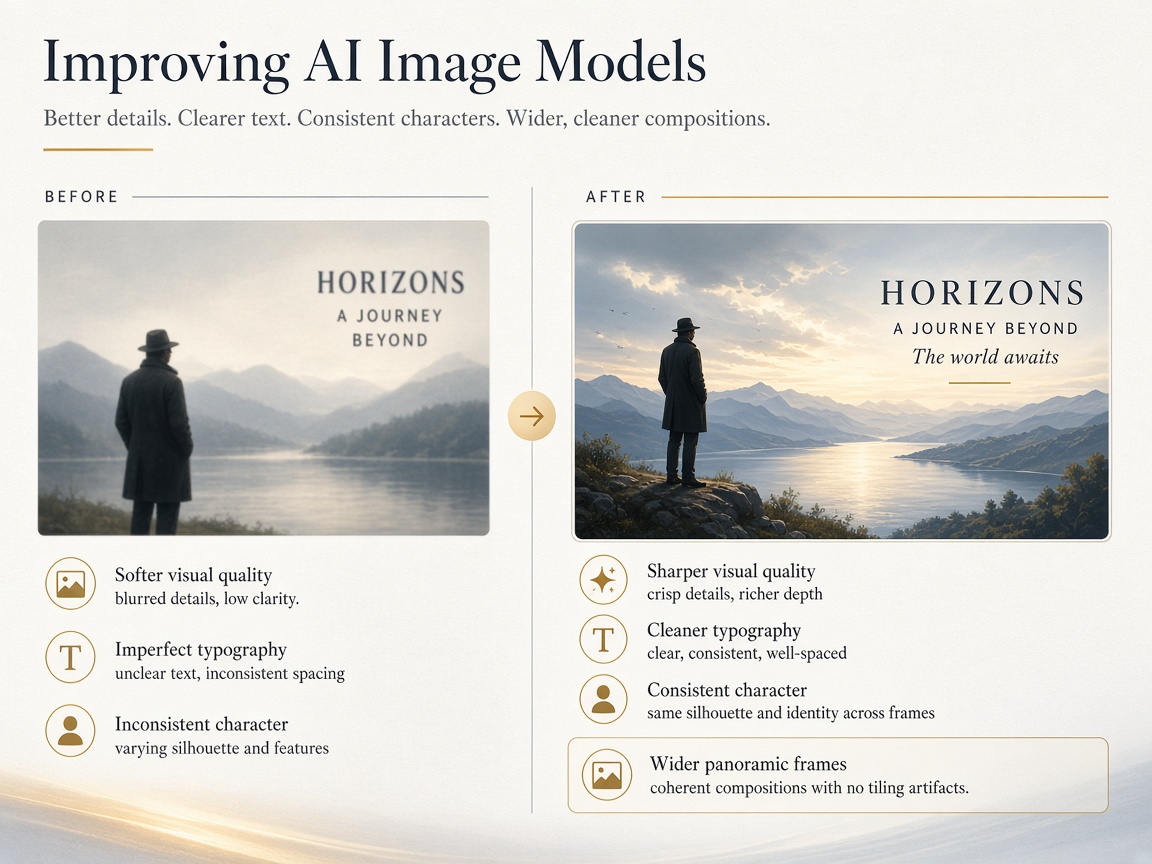
- Better Image Quality and Realism across 1K, 2K, and 4K outputs
- Stronger Prompt Adherence for complex generation and editing briefs
- Better Text and Infographic Rendering for layout-led creatives
- Better Character and Object Consistency across multi-turn conversational edits
- Better Wide and Panoramic Images, including fixes for tiling artifacts on ratios such as 1:4, 4:1, 1:8, and 8:1 at 2K and 4K
- More Control Over Thinking, with configurable levels (minimal, medium default, high)
Google also documents support for up to 14 reference images, with character resemblance for up to four characters and high-fidelity object handling for up to ten objects in a single workflow, plus Google Web + Image Search grounding.
Nano Banana 2 Review: Features and Capabilities
Nano Banana 2 is now the previous-generation model, but it remains useful as the baseline for understanding what changed in Nano Banana 2.1.
This section is a capability-based review of Nano Banana 2 (gemini-3.1-flash-image), based on Google’s published capabilities and public product materials. It is not an independent Designkit benchmark, and it does not score Nano Banana 2 against competitors. For a similar ecommerce-focused look at another image model, see our GPT Image 2 review. For Nano Banana vs Midjourney on product and campaign stills, see Nano Banana vs Midjourney.
Google positions Nano Banana 2 as a high-efficiency image generation and conversational editing model, with 4K output, multi-reference workflows, on-image text, and search grounding.
Image Quality
Capability: Google positions Nano Banana 2 as a high-efficiency image generation and conversational editing model, with 4K output, multi-reference workflows, on-image text, and search grounding.
Practical use: Useful for product concepts, campaign drafts, social creatives, and rapid visual iteration where turnaround matters as much as polish.
Limitation: Google still advises users to carefully check generated images for accuracy. This review does not independently grade photorealism or aesthetic preference.
Prompt Following
Capability: Google markets stronger instruction following for complex visual requests, so outputs more closely match multi-part creative briefs.
Practical use: In practice, this matters for ads, posters, and structured product scenes where subject, composition, materials, lighting, and exclusions need to land together — though complex briefs can still need iteration, and this review does not claim a measured accuracy score. For copy-paste product photo prompt patterns on another model family, see GPT Image 2 prompts for product photos.
Text Rendering
Capability: Google documents improved international text rendering and positions the model for readable in-image text on creatives such as posters, menus, stickers, and marketing assets.
Practical use: Relevant for packaging concepts, social cards, localized campaign variants, and layout-led graphics where short headlines or labels need to appear inside the image.
Limitation: Google explicitly says users should carefully check text in images for accuracy. For this review, we are not independently scoring typography accuracy or dense multi-line layouts.
Character Consistency
Capability: Gemini API documentation says Nano Banana 2 supports character resemblance for up to four characters in a single workflow.
Practical use: Useful for storyboards, campaign characters, mascot continuity, and multi-frame narrative concepts. Expect to re-anchor with references when identity drifts; this review does not independently measure long-run consistency.
Product Consistency
Capability: Google also describes object fidelity within multi-image workflows — up to ten high-fidelity objects in Gemini API docs for Nano Banana 2 — which matters when the same product must remain recognizable across scenes.
Practical use: Useful for ecommerce workflows where the same product needs to remain recognizable across studio, lifestyle, and campaign variations. Treat documented object fidelity as a capability claim, not a guaranteed match to every packaging detail.
Reference Image Editing
Capability: Google documents support for up to 14 reference images, with character resemblance for up to four characters and high-fidelity object handling for up to ten objects.
Practical use: Useful when you need to lock a face, product, outfit, palette, or existing frame, then refine the result with natural-language edits. This review does not independently measure how well identity holds across long edit chains.
Speed
Capability: Google positions Nano Banana 2 as the high-efficiency counterpart to Gemini 3 Pro Image, optimized for speed and high-volume use cases.
Practical use: Better aligned with draft-heavy creative loops — many variations for ads, thumbnails, and product angles — than with single “final art” renders alone. Exact latency still depends on resolution, tools, and platform; this review does not publish Designkit timing tests.
Resolution and Aspect Ratios
Capability: Google documents Nano Banana 2 output options including 0.5K, 1K (default), 2K, and 4K, plus expanded ratios such as 1:4, 4:1, 1:8, and 8:1.
Practical use: Practical for banners, stories, tall infographics, and wide hero frames that normally force awkward crops.
Limitation: Higher resolutions cost more tokens/time in real pipelines. Note that Nano Banana 2.1 keeps 1K–4K but does not document the 0.5K option that Nano Banana 2 supports.
Search Grounding
Capability: Nano Banana 2 supports Grounding with Google Search, including Image Search grounding alongside web search so generation can draw on real-time information and retrieved visual context.
Practical use: Useful for visuals tied to current events, real-world references, charts, maps, or subjects that benefit from up-to-date context.
Limitation: Google notes that real-world knowledge is not infallible — especially for infographics, diagrams, and data-heavy visuals. Always verify factual outputs. Google also notes that Image Search grounding currently does not support using real-world images of people from web search.
API / Developer Use
Capability: Nano Banana 2 remains available as gemini-3.1-flash-image, with image generation, conversational editing, search grounding options, and high-volume-oriented positioning.
Practical use: Still relevant for understanding the previous-generation baseline and for existing pipelines not yet migrated. Google now lists Nano Banana 2.1 (gemini-nano-banana-2.1) as the recommended replacement, with Nano Banana 2 scheduled for shutdown on October 29, 2026.
Bottom line for Nano Banana 2: It established the Flash-tier production baseline — fast generation, editing, references, wide formats, on-image text, and grounded visuals. Nano Banana 2.1 is Google’s current recommended update on that line.
Where to Try Nano Banana Models Today
Nano Banana 2.1
You can access Nano Banana 2.1 through Google's Gemini ecosystem, including the Gemini API and Google AI Studio. Availability may vary by product surface and account.
API model ID: gemini-nano-banana-2.1
Nano Banana 2
Still listed as the previous-generation model (gemini-3.1-flash-image), with a shutdown date of October 29, 2026. Google lists Nano Banana 2.1 as the recommended replacement.
Original Nano Banana
gemini-2.5-flash-image remains on a longer deprecation path, with a shutdown date of March 15, 2027. Keep this separate from the Nano Banana 2 → 2.1 migration timeline.
Prefer Google’s own surfaces when you need the real model family. Domain names that include “nano banana 2.1” are not proof of an official Google endpoint.
Create Ecommerce Product Visuals While You Migrate
Even after a model launch, ecommerce teams still need a production loop: turn a product image into lifestyle scenes, then into ad, social, and Amazon listing images you can ship.
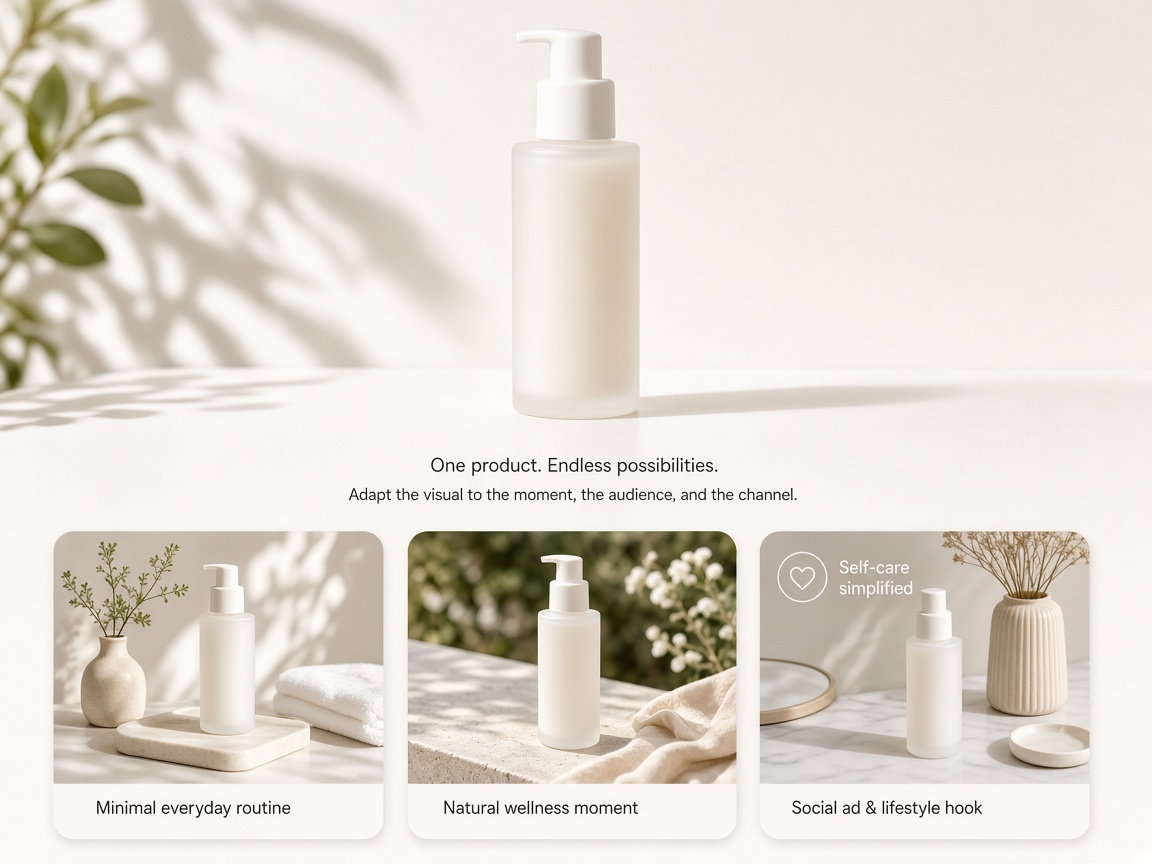
Designkit focuses on that loop — product image → lifestyle scene → ad/social variants → export — so campaigns keep moving while you evaluate or migrate image models.
How to start:
- Upload a clean product image.
- Choose a scene, style, and platform-ready format.
- Generate, refine, and export campaign variants.
Designkit is an ecommerce visual production tool. It is not a Google Nano Banana host and does not claim to be a substitute for Google’s official gemini-nano-banana-2.1 endpoint.
Conclusion
Nano Banana 2.1 is no longer just a Flow naming signal. Google officially released it on October 6, 2026 as the Stable update to Nano Banana 2, with the model ID gemini-nano-banana-2.1.
The update focuses on visual quality, prompt adherence, text rendering, multi-turn consistency, panoramic ratio handling, reference-image workflows, and search grounding, while maintaining the Flash-level efficiency of the Nano Banana 2 line.
If you are evaluating Nano Banana models today, Nano Banana 2.1 is the current high-efficiency baseline. Nano Banana 2 remains useful as the previous-generation comparison point — but teams still calling gemini-3.1-flash-image should plan migration before the October 29, 2026 shutdown date.
For ecommerce teams, the practical question is no longer whether Nano Banana 2.1 will launch, but how its documented capabilities fit into the AI image generation and editing workflow you already use.
Keep producing product and campaign visuals with Designkit — and use Google’s official surfaces when you need gemini-nano-banana-2.1 itself.
Frequently Asked Questions
What is Nano Banana 2.1?
Is Nano Banana 2.1 officially released?
Yes. Google released Nano Banana 2.1 on October 6, 2026. It is listed as a Stable model in the Gemini API.
When is the Nano Banana 2.1 release date?
October 6, 2026.
Is Nano Banana 2.1 the same as Nano Banana 2.5 Flash?
Before launch, Flow references briefly used “Nano Banana 2.5 Flash,” then “Nano Banana 2.1.” The shipped Stable model ID is gemini-nano-banana-2.1. Google does not ship a separate public model under the 2.5 Flash name.
Is Nano Banana 2.1 the same as Gemini 3.1 Flash Image?
No. Gemini 3.1 Flash Image is Nano Banana 2 (gemini-3.1-flash-image). Nano Banana 2.1 is the update model gemini-nano-banana-2.1.
Is Nano Banana 2.1 better than Nano Banana 2?
Google positions Nano Banana 2.1 as an update with improved visual quality, prompt adherence, multi-turn consistency, and text rendering while maintaining Flash-level speed and cost efficiency. Independent testing may produce different results for specific use cases.
Does Nano Banana 2.1 have an API?
Yes. Its Stable Gemini API model ID is gemini-nano-banana-2.1.
Where can I try Nano Banana 2.1?
You can access Nano Banana 2.1 through Google's Gemini ecosystem, including the Gemini API and Google AI Studio. Availability can vary by product surface and account.
Should I migrate from Nano Banana 2 to Nano Banana 2.1?
Yes, if you rely on Nano Banana 2 / gemini-3.1-flash-image. Google lists Nano Banana 2.1 as the recommended replacement, and Nano Banana 2 has an October 29, 2026 shutdown date in the current deprecations schedule.
You May Also Like

Nano Banana vs Midjourney for Product Photos and Campaign Visuals (2026)

GPT Image 2 Prompts for Product Photos (Copy-Paste Examples)
Best AI Image Generator Tools in 2026: Top AI Platforms Compared
Fotor AI Image Generator Review: Features, Pricing & Alternatives
Bing Image Creator: How It Works, Features, Uses & Alternatives

Studio Product Photography vs AI Product Photography in 2026

Top 5 AI Tools to Generate Amazon Product Listing Images in 2026
Amazon Photography Service vs. AI Generator: Best Choice for Sales
How to Use Grok AI: Features, Tips & Best Prompts (2026 Guide)
Sora Is Shutting Down? Best AI Video Alternatives for Creators in 2026
Create More With AI Image Generation
Turn product images into lifestyle scenes, campaign visuals, and social creatives with Designkit’s AI-powered workflow.