
What Is a Brand Video? Types, Examples, and How to Create One That Converts
Learn what a brand video is, the main types, and how to build storytelling content that converts. Turn product images into social-ready videos for TikTok, Reels, and ads in a few clicks.


Brand videos help businesses tell their story in a way that audiences can actually remember. Instead of focusing purely on products or promotions, they highlight what a brand stands for, what makes it different, and why people should care.
Today, brand videos appear everywhere: from ecommerce stores and landing pages to TikTok, Instagram Reels, YouTube, and paid advertising campaigns. Brands use them to build trust, create emotional connections, and stay top of mind in increasingly crowded markets.
The challenge is that traditional video production can be expensive, time-consuming, and difficult to scale. Fortunately, creating high-quality brand videos is much easier than it used to be. With AI-powered tools, businesses can turn existing product images, brand assets, and creative ideas into professional videos without the cost and complexity of a full production process.
In this guide, you'll learn what a brand video is, explore the most common types and examples, and discover practical strategies for creating brand videos that engage audiences and support business growth.
What is a brand video and why does it matter?
A brand video is a type of marketing video that communicates what a company stands for, its identity, values, mission, and personality. Unlike performance ads that focus on immediate conversions, brand videos are built for longer-term impact: earning trust, shaping perception, and strengthening brand recognition over time.
Common formats include brand story videos, product-led brand films, customer testimonials, behind-the-scenes content, and social campaign videos.
In a digital landscape where audiences are exposed to thousands of messages every day, attention alone isn't enough. Brands also need to be remembered and trusted. A strong brand video helps people understand not just what a company sells, but why it exists and what it believes in.
By combining storytelling, visual direction, and emotional context, brand videos make a business more recognizable and more relatable. Over time, this contributes to stronger recall, deeper engagement, and higher trust.
For eCommerce brands in particular, brand videos can also improve perceived product value, increase engagement across social channels, and support better conversion rates on product pages, landing pages, and paid campaigns.
What makes a great brand video?
A strong brand video doesn't just showcase products or services. It communicates identity in a way that feels clear, consistent, and relevant to the audience.
Instead of focusing on short-term promotion, effective brand videos are built to establish an emotional connection and long-term brand memory.
The best ones tell a focused story, helping viewers understand who the brand is, what it stands for, and how it fits into their world.
This can take many forms: founder narratives, customer stories, behind-the-scenes perspectives, or lifestyle-driven scenarios.
What matters is not the format itself, but whether the story feels authentic and intentional. A well-executed brand video leaves a lasting impression that extends beyond a single view or transaction.
Key characteristics of a successful brand video:
-
Focuses on brand values and identity, not just products
-
Builds emotional connections with the target audience
-
Uses storytelling rather than direct sales messaging
-
Creates consistent brand recognition across channels
-
Supports long-term trust, loyalty, and customer engagement
Brand video vs product video vs ad video
|
Aspect |
Brand Video |
Product Video |
Ad Video |
|---|---|---|---|
|
Purpose |
Build identity and trust |
Explain product features |
Drive immediate conversions |
|
Length |
30s – 3 min |
15s – 2 min |
6s – 60s |
|
Platform |
YouTube, Instagram, websites |
E-commerce pages, social media |
Paid ads (Meta, TikTok, Google) |
|
Goal |
Awareness + emotional connection |
Product understanding |
Sales + clicks |
Types of brand videos and where each one works best
Not all brand videos are designed to do the same job. Some are built for storytelling, others for product education, and others for building trust or community. The right format depends on your objective, your audience, and where the content will be distributed.
Below are the most common types of brand videos and where they typically perform best.
Brand story videos
Brand story videos communicate a company's mission, values, and identity through narrative-driven content. Instead of focusing on products, they focus on meaning—why the brand exists and what it stands for.
They are commonly used on homepages, YouTube channels, and key landing pages where first impressions matter most. For many brands, this becomes the "intro" video that sets the tone for everything else.
-
Best for: brand positioning, emotional storytelling, and awareness
-
Where they work best: homepage hero sections, YouTube, and brand landing pages
Product-focused brand videos
Product-focused brand videos combine brand identity with clear product demonstrations. They show how a product works in real contexts, while keeping visual consistency with the overall brand.
These videos are especially effective in eCommerce environments where users need clarity before making a purchase decision.
-
Best for: product education and conversion support
-
Where they work best: Shopify product pages, Amazon listings, and paid ad campaigns
Social media brand videos
Social media brand videos are short-form, mobile-first, and designed for fast consumption. They prioritize attention capture and platform-native storytelling over detailed explanation.
They often vary in format — quick demos, visual hooks, or lightweight storytelling—and are optimized for iteration across channels.
-
Best for: reach, engagement, and short-form visibility
-
Where they work best: TikTok, Instagram Reels, and YouTube Shorts
Customer testimonial and community videos
Customer testimonial and community videos rely on real user experiences to build credibility. Instead of brand-led messaging, they use social proof to communicate value.

These formats tend to perform strongly across both organic and paid channels because they feel more grounded and less promotional.
-
Best for: trust building and social proof
-
Where they work best: landing pages, product pages, and social campaigns
Behind-the-scenes and culture videos
Behind-the-scenes and culture videos show how a brand actually operates—its people, processes, and day-to-day environment. This format is less about polish and more about transparency.
They are often used to humanize the brand and build long-term familiarity, especially in competitive markets where differentiation is difficult.
-
Best for: authenticity and brand trust over time
-
Where they work best: LinkedIn, company websites, and Instagram Stories
How to create a brand video that connects with your audience
A strong brand video does more than explain a product or service. It communicates identity: what your brand stands for, who it's for, and why it matters. The videos that perform best tend to combine audience insight, clear narrative structure, and consistent visual execution.
Start with audience pain points
Before thinking about scripts, visuals, or editing styles, start with the audience. Effective brand videos are grounded in real problems, motivations, and decision triggers.
When a video reflects what people are already thinking or struggling with, it immediately feels more relevant.
Key questions to clarify:
-
What problem is the audience trying to solve?
-
What friction, frustration, or uncertainty are they dealing with?
-
What does success look like from their perspective?
This foundation shapes everything that follows: from messaging to visual direction.
Use a simple storytelling framework
Most effective brand videos follow a clear narrative structure instead of relying on disconnected visuals. A simple framework that works across formats is:
Problem
Show a challenge your audience can immediately recognize and relate to.
Emotion
Highlight how that challenge affects their daily work, goals, or experience.
Transformation
Show how the situation improves and what success looks like after the problem is solved.
This structure is widely used in brand storytelling, social ads, landing page videos, and eCommerce content because it keeps the message focused and easy to follow.
Maintain visual consistency
Consistency is what turns individual videos into a recognizable brand system. When visuals stay aligned across platforms, audiences begin to associate a specific style with your brand.
Key elements to keep consistent:
-
Brand colors
-
Typography
-
Logo placement and usage
-
Editing rhythm and pacing
-
Overall visual tone
Whether the video appears on YouTube, TikTok, Instagram, or your website, consistency helps reinforce recognition and builds a more cohesive brand presence over time.
Repurpose content across platforms
A single brand video can support multiple distribution channels if structured correctly from the start. Instead of producing separate assets for each platform, it is more efficient to design one core video and adapt it into multiple formats.
Common adaptations include:
-
Long-form YouTube videos
-
Short-form TikTok clips
-
Instagram Reels and Stories
-
Product page videos for Shopify
-
Amazon listing videos
Repurposing extends reach, reduces production overhead, and keeps messaging consistent across the full marketing funnel.
How AI makes brand video creation faster?
Creating a professional brand video has traditionally involved multiple stages: planning, shooting, editing, and producing variations for different channels. For many teams, this means high production costs, long turnaround times, and limited capacity to scale content output.
AI has changed this workflow by removing the need to start from scratch. Instead of relying on full production cycles, AI brand video tools can generate ready-to-use videos from existing product images, brand assets, and simple creative inputs. This makes it significantly easier to produce content across ecommerce, social media, and advertising channels while maintaining visual consistency.
Benefits of using AI for brand videos
AI-powered video tools help teams streamline production and scale output without increasing complexity. Key advantages include:
-
Reduced production time and lower costs
-
No need for filming or studio setups
-
Fast generation of multiple creative variations
-
Easier adaptation for different platforms and formats
-
Consistent branding across campaigns and channels
For ecommerce and marketing teams, this means more content can be produced with the same resources, making it easier to keep up with multi-channel demands.
How to create a brand video with Designkit?
Designkit simplifies the process of turning static brand assets into ready-to-publish videos in a structured workflow.
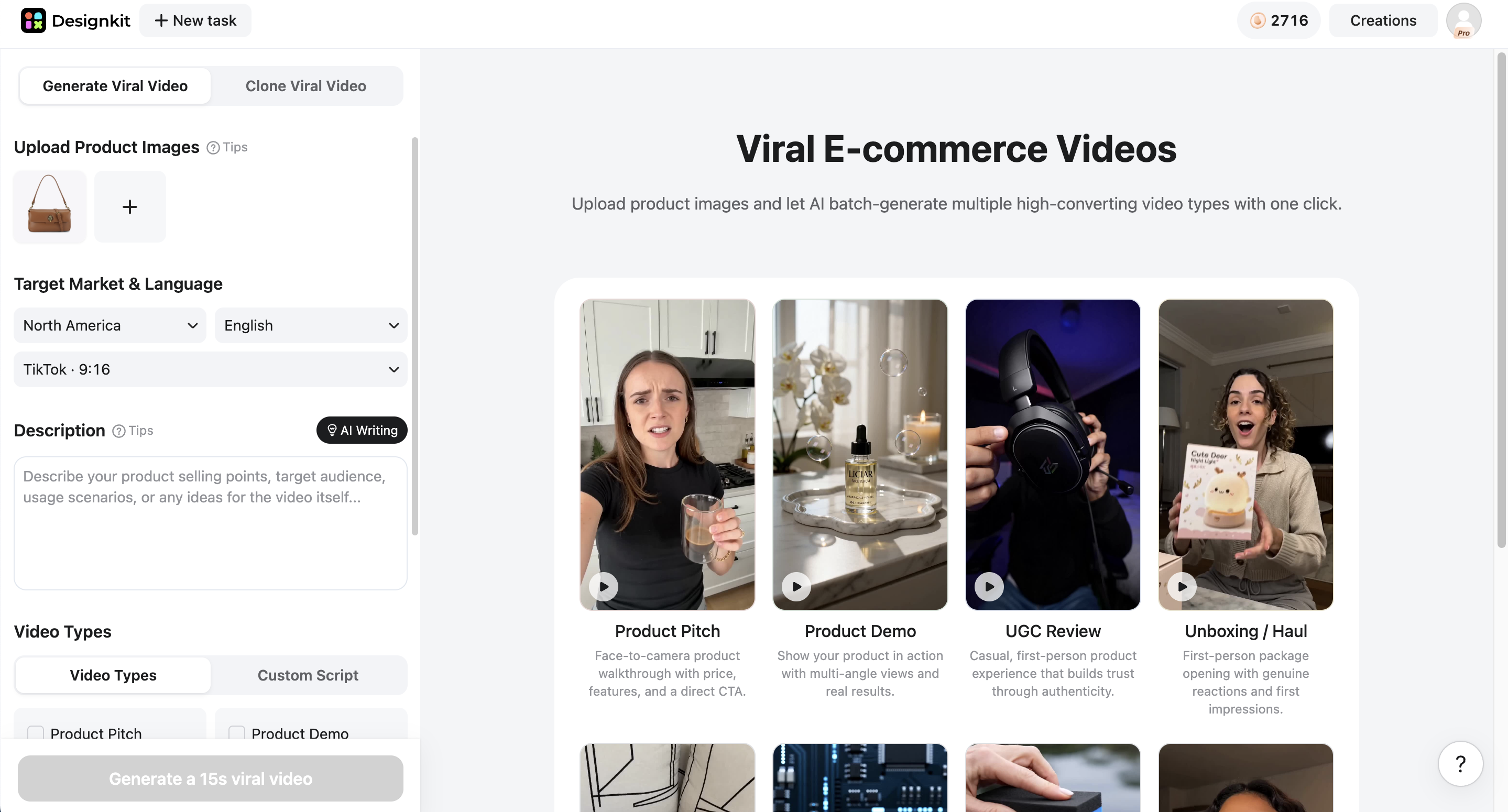
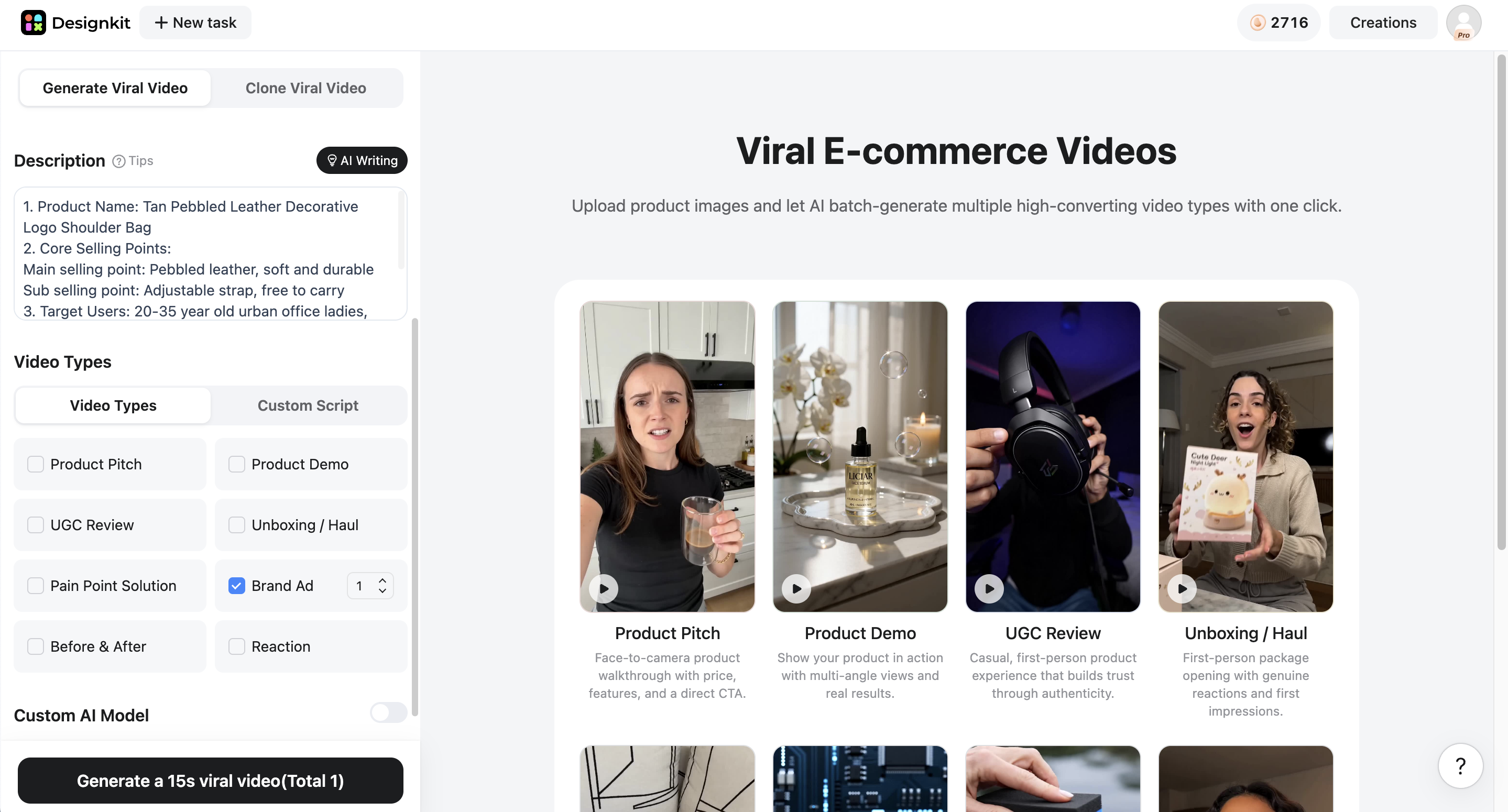
Step 1: Upload your brand assets
Start by uploading product images, logos, and other brand materials. You can also define your brand style, target audience, and campaign objective to guide the output more precisely.
Step 2: Choose a creative direction
Select a video format based on your marketing goal, such as brand story, product showcase, UGC-style ads, emotional storytelling, or before-and-after content.
You can also upload a reference video to generate new variations that follow a similar creative direction.
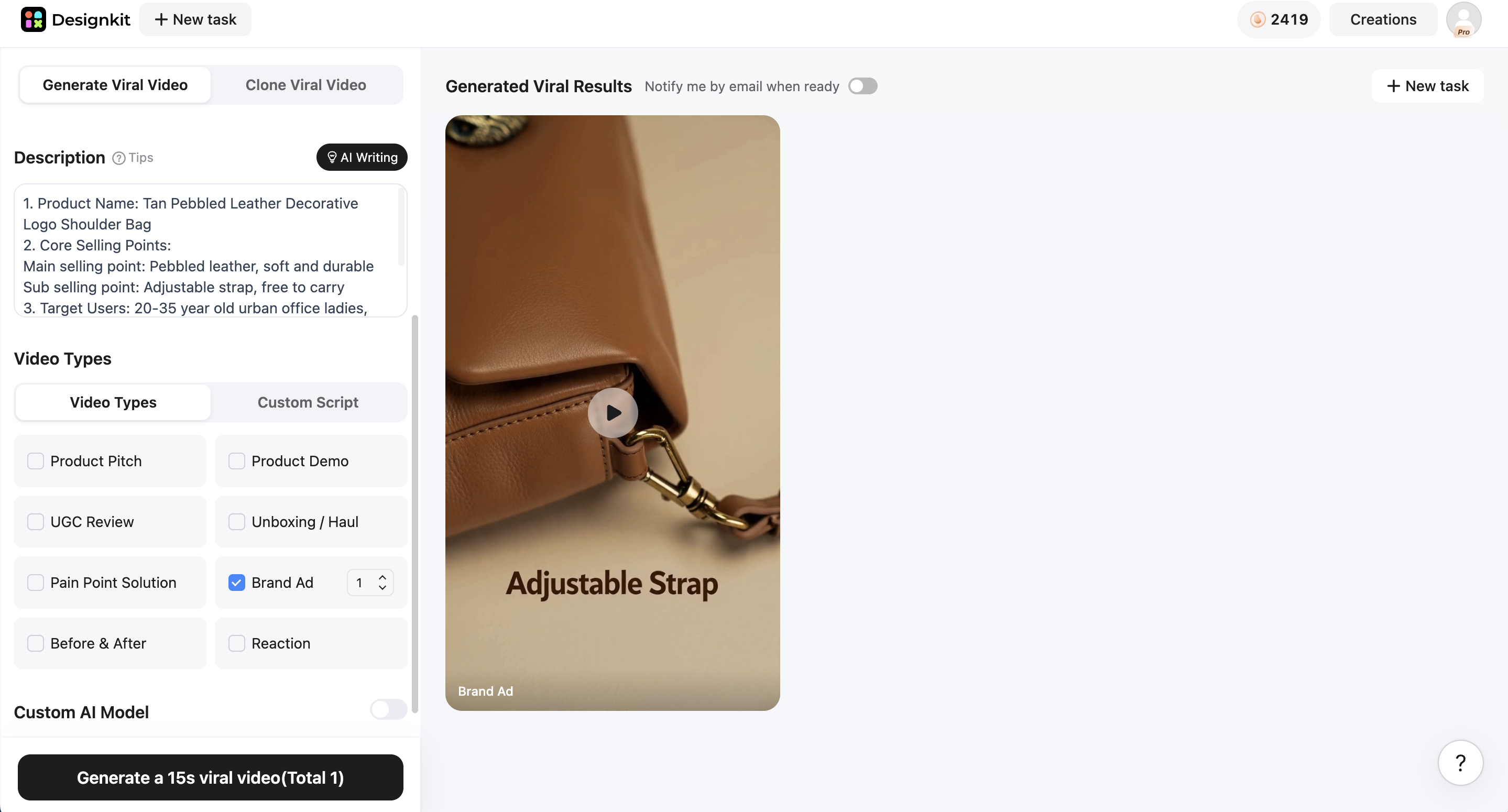
Step 3: Generate platform-ready videos
Designkit generates multiple video variations optimized for different channels, including social media, ecommerce product pages, and paid ad campaigns. Outputs can be exported in different aspect ratios without additional editing work.
Why use Designkit for brand videos?
Turn existing assets into video content
Instead of organizing a shoot or producing new footage, existing product photos, logos, and visuals can be transformed directly into video content.
Create once, publish everywhere
A single workflow can generate videos for TikTok, Instagram Reels, YouTube Shorts, product pages, and ad platforms while maintaining consistent branding across channels.
Automatically adapt videos for every platform
Designkit supports multiple formats: vertical, square, and horizontal, generated from the same assets. This reduces the need to recreate content for each platform while keeping visual identity aligned.
Common brand video mistakes and how to fix them
Brand videos usually underperform not because the concept is wrong, but because execution gets misaligned — story, structure, or distribution don't work together. The good news is that most of these issues are straightforward to correct once identified.
Focusing only on aesthetics
A common mistake is prioritizing cinematic visuals, transitions, and effects while leaving the message underdeveloped. High production value can attract attention, but it doesn't guarantee clarity or retention.
When the narrative is weak, even well-edited videos tend to feel empty or forgettable.
How to fix it
-
Start from audience needs and pain points before thinking about visuals
-
Define the core message before selecting styles or effects
-
Treat design as support for storytelling, not the other way around
-
Keep visual direction consistent with brand purpose and tone
Making videos too promotional
Brand videos are more effective when they provide value before asking for a sale. If every scene focuses on a product or offer, viewers may disengage before the message has a chance to resonate.
The strongest videos build interest first, helping viewers understand why the content matters before introducing a product, service, or call to action.
How to fix it
-
Shift focus from product features to user experience and outcomes
-
Use narrative flow instead of direct selling language
-
Show real-world usage rather than abstract claims
-
Add informational or entertaining value before asking for action
Ignoring mobile-first viewing
A significant portion of brand video consumption now happens on mobile. Videos designed primarily for desktop often fail in this environment due to framing, pacing, or readability issues.
This is especially noticeable on TikTok, Instagram Reels, and YouTube Shorts, where attention is highly fragmented.
How to fix it
-
Design for vertical or mobile-first formats when possible
-
Ensure text remains readable on small screens
-
Open with strong visual or narrative hooks in the first seconds
-
Use captions for silent or autoplay viewing contexts
Ignoring the product assets you already have
Many brands overlook existing materials and default to producing new footage from scratch. In practice, product photos, UGC, testimonials, and past campaigns often contain enough raw material to build effective brand videos.
This leads to unnecessary production costs and inconsistent visual output.
How to fix it
-
Repurpose product photography into motion-based storytelling
-
Turn customer reviews into testimonial-driven content
-
Re-edit existing campaigns into short-form variations
-
Adapt ecommerce assets for different platform formats
Using existing assets strategically not only reduces production effort but also improves consistency across channels.
Conclusion
Brand videos are now a core part of how modern businesses build trust, communicate identity, and drive conversions across eCommerce, social media, and paid advertising.
The most effective videos are not defined by production complexity alone, but by how well they align three elements: clear brand storytelling, audience relevance, and platform-specific formats. When these work together, videos become more than content—they become a consistent part of how customers understand and evaluate a brand.
For teams looking to scale production without increasing complexity, tools like Designkit help turn existing product assets into ready-to-publish brand videos. This makes it easier for brands of any size to create consistent, high-quality content across multiple channels without relying on traditional production workflows.
Frequently Asked Questions
What are the best brand video examples?
How do I create a brand video that increases conversions?
A high-converting brand video starts with audience pain points and clearly communicates how a product or service improves the customer's situation. Effective videos use strong storytelling, clear messaging, mobile-friendly formats, and platform-specific optimization. Instead of focusing solely on product features, they emphasize outcomes, benefits, and real-world value.
What is the difference between a brand video and a commercial?
A brand video focuses on building trust, emotional connection, and long-term brand awareness, while a commercial is designed to drive immediate action, such as a purchase, signup, or click. Brand videos tell stories about a company's mission, values, and identity, whereas commercials are typically more promotional and sales-driven.
What is involved in professional brand video production?
Professional brand video production usually includes strategy development, scripting, creative planning, filming, editing, motion graphics, sound design, and platform optimization. Many brands also create multiple versions for social media, advertising campaigns, websites, and ecommerce product pages to maximize reach and performance.
Can I create a brand video without filming?
Yes, many businesses now create brand videos using existing product photos, graphics, logos, customer content, and other brand assets. AI-powered tools can transform these assets into professional videos, making it possible to produce branded content without traditional filming or complex editing workflows.
What is an AI brand video generator?
An AI brand video generator is a tool that automatically converts images, video clips, product assets, and creative inputs into finished marketing videos. These tools help brands create content faster by generating scenes, animations, transitions, and multiple video variations while maintaining a consistent visual style across campaigns.
Which is the best brand video maker for small businesses?
The best brand video maker depends on your goals, budget, and content requirements. Small businesses often look for tools that simplify video creation, branding, resizing, and content repurposing across platforms. Solutions like Designkit help businesses generate brand videos from existing assets, making it easier to create content for ecommerce stores, social media, and advertising campaigns without extensive production resources.
You May Also Like
Short Form Video Marketing for E-commerce: AI Video Guide

What Is Video Marketing? E-commerce Guide & Strategies 2026

AI Fashion Models vs Real Models: Which Is Better for Brands?
How AI Virtual Try-On Helps Fashion Brands Boost Sales & Reduce Returns
How to Add Video to eBay Listing: Step-by-Step Seller Guide
Short Form Video Marketing for E-commerce: AI Video Guide
Boost your brand visibility with high-converting brand videos
Turn product images into engaging storytelling videos in minutes with Designkit, no filming or editing required.